Reference · checklist
Storm season checklist
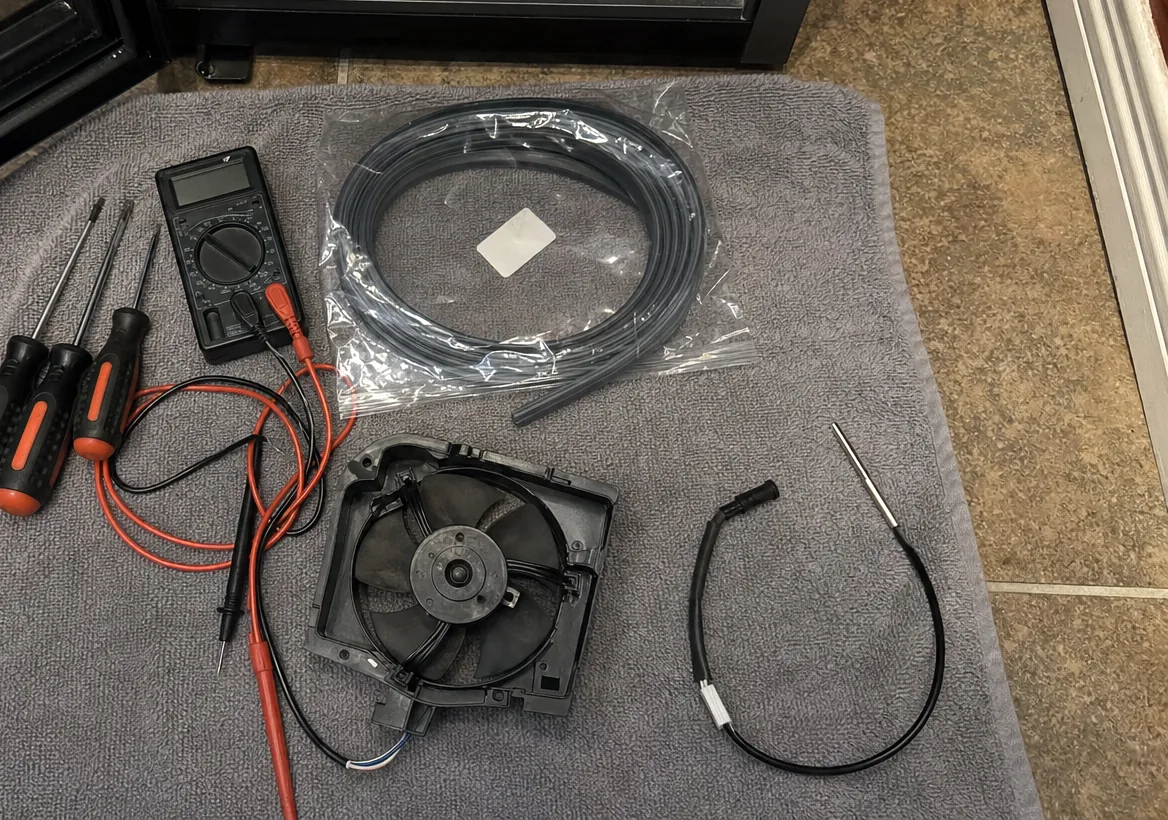
Northeast Florida averages around 68 thunderstorm days a year. That is not a marketing statistic; it is the reason a disproportionate share of the control boards we replace fail between June and September, and the reason we run a specific checklist on any appliance whose trouble started with a storm.
What actually kills a board
Direct strikes are rare and dramatic. What is common is far less exciting: a voltage transient induced on the supply by a nearby strike, or by the utility switching the circuit back after an outage. Modern appliance controls run low-voltage logic behind a power supply, and that supply is where transients land. The failure is usually the supply section rather than the processor, which is why a board can go completely dead while every mechanical part of the appliance is perfect.
The second, quieter killer is the restart itself. A compressor asked to start against a system that has not equalised draws heavy current, and repeated attempts during a flickering restoration are harder on a start component than one clean start ever is.
After the power comes back
Work through this before concluding anything is broken.
- Wait. Give a refrigerator a full 24 hours before judging its temperature. It has to remove all the heat that entered while it was off.
- Expect the restart delay. Many controls hold the compressor off for three to five minutes after power is restored to let pressures equalise. A refrigerator that is silent for a few minutes is behaving correctly.
- Check the breaker, then check it properly. A breaker that has tripped may not look tripped. Switch it fully off and back on.
- Look for a control lockout. Some appliances enter a fault or demo state after an abnormal shutdown and need a deliberate reset rather than a repair.
- Measure, do not guess, on the refrigerator. Thermometer in a glass of water, mid-shelf, four hours. Food that spent an extended period above 40°F is a food-safety decision, not an appliance decision.
- Listen at the condenser. A compressor attempting to start and dropping out on its overload every few minutes has a distinctive rhythm — a click, a hum, silence, repeat. Stop and call rather than letting it cycle for days.
- Check the ice machine’s drain and bin. A machine that sat warm for a day has melted its bin, and standing water is the first thing to clear.
What we can and cannot repair
Control boards are replaced, not repaired at the component level, and we will not pretend otherwise. What we can do is establish that the board is genuinely the fault before you buy one, because a dead appliance after a storm is not automatically a dead board — a tripped thermal cutoff, a failed relay, an open fuse on the board itself, or a supply problem in the house all present the same way.
On an older appliance with an expensive board, that diagnosis is worth doing carefully. A board is often the single most expensive part in the machine, and replacing one on a unit that has already had two other failures deserves a frank conversation about the remaining life of everything around it.
Prevention that is actually worth doing
Whole-home surge protection at the panel is the only measure that addresses hard-wired appliances — a plug-in strip cannot protect a range or a built-in oven that has no plug you can reach. It is electrical work for a licensed electrician, not something we install, and we have nothing to sell you on it. Point-of-use protection is still worthwhile for anything that does plug in, including undercounter refrigeration and ice machines.
The other prevention is unglamorous and free: if a storm is forecast and you are going to be away, there is no harm in letting a plumbed ice machine finish its cycle and switching it off at the breaker. It is the appliance most likely to make a mess if it fails mid-cycle while nobody is home.
Not every summer fault is a storm fault
Appliance complaints cluster in the same months as thunderstorms, and most of them are unrelated to the weather on the day they are reported. Summer is simply when a kitchen asks for everything its equipment can produce, and when the ambient temperature around a condenser is at its highest. A refrigerator with a fouled condenser or a slowing condenser fan holds temperature comfortably in March and runs out of margin in August; an ice machine that has been losing a little output every month is only noticed when the household finally needs a full bin.
The question that separates the two is the shape of the decline, not the date. Output that fell away gradually over months points at heat load, air path and maintenance. Output that stopped in a single evening, or an appliance that is completely dead, points at the electrical side — and if that evening had a storm in it, start with the board and the supply.
What does the work on this sheet cost before anyone has seen it?
Two figures decide this, and the schedule below carries both. The first is $80: a technician and a meter in front of the appliance, taken off the bill the moment you approve the repair. The second is the one band on this book that covers the work on this sheet: control board or touch panel, parts and labour counted together, read off jobs of that class in St. Johns County rather than off a manufacturer list. The book carries no band of its own for the rest of it, so anything else the visit turns up is priced on the written estimate after the diagnostic instead of being guessed at in advance.
| Band | Parts + labour | What lands in it |
|---|---|---|
| Diagnostic visit | $80 | Flat, credited to the repair when you approve it |
| Control board or touch panel | $410–$1,030 | board · control · panel · touch |
A written estimate comes before any part is ordered or any labor is billed. A band says where this class of work usually lands. It is not a quote, and three things move a job inside it: how the appliance has to be reached, whether the part is stocked or ordered, and whether the number on the plate has been superseded since. The full schedule and the terms sit on the pricing sheet.
Storm season checklist — questions from the kitchen side
- What actually kills a control board in a storm?
- A transient arriving on the supply, which lands on the low-voltage section of the board. Every mechanical part of the appliance can be perfect while the board is completely dead, and that is why storm damage is treated here as its own fault class rather than as wear.
- The power came back days ago and the appliance failed this week. Related?
- It can be. The damage is not always immediate, and a board or an inverter-driven compressor can run for weeks after the event before it quits. If an appliance stopped in the same season the power did, say so, because it changes where we start.
- Is surge protection worth fitting to a built-in?
- On anything with a board behind it, yes, and it costs a fraction of the board. This part of Florida averages around sixty-eight thunderstorm days a year, and that is the exposure these appliances genuinely live with rather than a number chosen to sell protection.
Visits where this sheet decided the answer
Each slip below is one visit, in the words of the person who paid for it. The awkward ones are printed with the rest. More from the 78 we publish.
Two burners had orange tips and were sooting the bottoms of the pans. He checked gas pressure at the manifold, reset the air shutters and cleaned the ports out. Blue flames and clean pans again.
Eleanor T.2025-11-28
Constant clicking with no light, and it had started the day I cleaned the top. He told me on the phone to leave it an hour to dry, it still clicked, and the electrode ceramic turned out to be cracked.
Rufus W.2026-02-18
The range works properly now and the diagnosis was careful, but the scheduling was a mess. Two appointments were moved before anyone arrived, and I only heard about the second one because I chased it.
Katya S.2025-09-27
Where this sheet is used
A site-wide reference: every service page on the site works against it.
Viking kitchen appliances — and nothing mechanical in the house
Greenleaf Appliance Service repairs built-in kitchen appliances — the Viking equipment specified into a kitchen and installed in it, plus the outdoor cooking equipment that was specified with it. Home heating, air conditioning, heat pumps, air handlers and the ductwork that serves them are not work this shop takes, in Nocatee or anywhere else inside the radius. A hood duct, a condenser air path and the cooling load on a built-in are appliance work and we measure all three; the house's own mechanical systems belong to a mechanical contractor.
Viking on this site is the kitchen-appliance manufacturer. There is also a place called Viking in Indian River County, well south of St. Johns County; this shop does not work there, and it does not service heating or cooling equipment anywhere.
On the sheet
- Ranges, rangetops and cooktops
- Wall ovens, single and double
- Built-in and freestanding refrigeration
- Undercounter ice machines
- Dishwashers
- Range hoods and their blowers
- Outdoor cooking equipment specified with the kitchen
Off the sheet
- Home heating and furnaces
- Central air conditioning and heat pumps
- Air handlers and house ductwork
- Water heaters and pool equipment
- Laundry equipment