Reference · reference
Hood airflow and makeup air
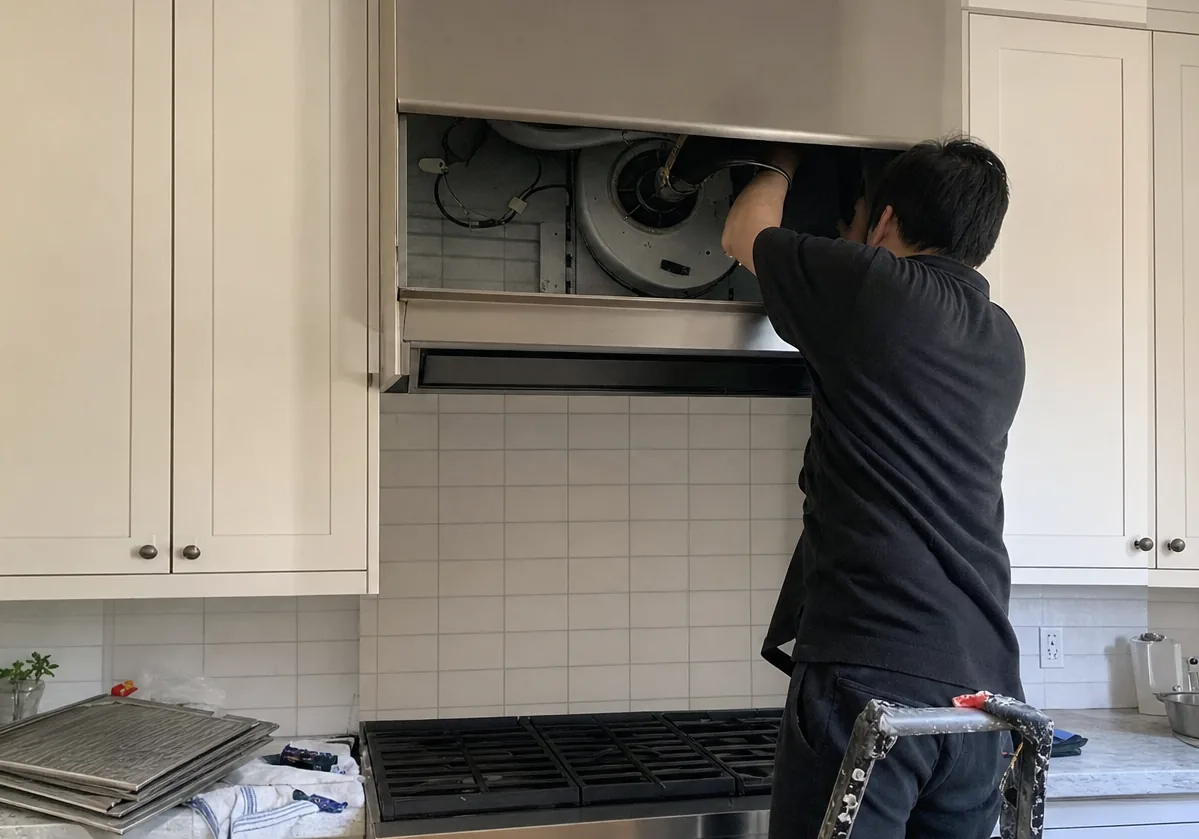
A hood that does not clear steam is usually not a broken hood. It is a hood attached to a duct that cannot carry what the blower can move, or installed in a house that cannot supply the air the blower is trying to remove. Both problems look identical from the kitchen, and neither is fixed by a new motor.
A fan can only move air that can get in
This is the part that surprises people. Exhaust is not a one-way process — for every cubic foot the hood pushes out of the house, one cubic foot must come in from somewhere. In a leaky old building it arrives through the building itself and nobody notices. In a tight modern envelope there is nowhere for it to come from, and the fan simply stalls against the pressure it has created.
Nocatee houses were built from 2007 onward to a considerably tighter standard than the 1920s stock in the historic Duval neighbourhoods. That is excellent for cooling bills and it is precisely what makes powerful kitchen ventilation require planning here.
The symptoms of a house with no makeup air path are recognisable:
- Exterior doors are noticeably harder to pull open while the hood is on high
- A whistle or draught at a closed window or a door frame
- The hood works visibly better with a window cracked
- The dryer or a combustion appliance struggles to vent
- The hood is quiet and moving nothing, rather than loud and moving nothing
Widely adopted residential mechanical code requires a makeup air path once exhaust capacity exceeds 400 cfm, and professional hoods routinely exceed that figure on their top speed. If your house shows the symptoms above, this is a building question for a licensed mechanical contractor, not a repair. We will identify it and tell you, because selling you a blower for it would be selling you nothing.
The duct is half the system
Manufacturer airflow figures are measured on a test rig, not on your duct run. What your hood actually delivers depends on the path.
Diameter. Airflow resistance rises sharply as duct diameter falls. A blower sized for a large-diameter duct loses a great deal of its capacity through a transition that necks the run down — which happens routinely when a bigger hood is fitted to an existing duct.
Material. Flexible duct has several times the resistance of smooth-wall rigid duct of the same diameter, and a flex run that sags between joists is worse than that. If a hood has never performed since move-in, look here first.
Length and elbows. Every foot of duct and every change of direction adds resistance. Two ninety-degree elbows close together cost far more than the same two elbows separated by a straight section.
Termination. The cap at the roof or wall has a backdraft damper. Grease stiffens it, exterior paint seizes it, and a damper that does not open fully throttles the whole system.
What we can actually service
The hood itself is straightforward. Baffle filters go through the dishwasher on a four-week cycle in a household that cooks most nights, and a loaded set is frequently most of an airflow complaint on its own. Blowers that have changed pitch usually have a bearing going or a wheel unbalanced by accumulated grease, and cleaning and rebalancing the wheel is often enough. Speed faults split cleanly: one speed working and the others not points at the switch or the speed board, and nothing working at any speed points at the supply. Canopy lighting is generally a low-voltage circuit with a driver, so a whole side going dark is a driver or a connector rather than lamps.
What we will not do is replace a working component to compensate for a duct or a building. That is the whole point of measuring before quoting.
Salt air is not a factor at this ZIP
Corrosion of hood hardware, fasteners and exterior caps is a genuine issue on the coastal ZIPs — 32082, 32250, 32266, 32233 and 32084 among them. Nocatee’s 32081 is not one of them. Hardware here corrodes at ordinary inland rates, and we do not bill time looking for a problem the geography does not produce.
What does the work on this sheet cost before anyone has seen it?
Two figures decide this, and the schedule below carries both. The first is $80: a technician and a meter in front of the appliance, taken off the bill the moment you approve the repair. The second is the one band on this book that covers the work on this sheet: control board or touch panel, parts and labour counted together, read off jobs of that class in St. Johns County rather than off a manufacturer list. The book carries no band of its own for the rest of it, so anything else the visit turns up is priced on the written estimate after the diagnostic instead of being guessed at in advance.
| Band | Parts + labour | What lands in it |
|---|---|---|
| Diagnostic visit | $80 | Flat, credited to the repair when you approve it |
| Control board or touch panel | $410–$1,030 | board · control · panel · touch |
A written estimate comes before any part is ordered or any labor is billed. A band says where this class of work usually lands. It is not a quote, and three things move a job inside it: how the appliance has to be reached, whether the part is stocked or ordered, and whether the number on the plate has been superseded since. The full schedule and the terms sit on the pricing sheet.
Hood airflow and makeup air — questions from the kitchen side
- What is makeup air, in one sentence?
- The cubic foot that has to come into the house for every cubic foot the hood pushes out of it. A leaky old building supplies it through itself; a tight modern envelope has nowhere for it to come from, and the fan stalls against the pressure it has created.
- Does a bigger blower fix a hood that moves nothing?
- Rarely. Airflow is the product of the fan and the path, and the path is usually what failed: a transition necking the duct down, a flex run sagging between joists, elbows stacked together, or a termination damper stiffened with grease. Selling you a motor for any of those would be selling you nothing.
- What does the 400 cfm threshold mean for my house?
- That once exhaust capacity passes it, residential mechanical code commonly requires a makeup-air path, and professional hoods routinely exceed it on their top speed. Where a house shows the symptoms, that is a building question for a licensed mechanical contractor rather than an appliance repair.
Visits where this sheet decided the answer
Each slip below is one visit, in the words of the person who paid for it. The awkward ones are printed with the rest. More from the 78 we publish.
The hood sounded strong and cleared nothing at all. He measured at the duct, showed me the flexible run sagging between the joists and said a new blower would not change it. That answer cost him the bigger job.
Yvonne S.2026-07-30
Two burners would light and then drop out the moment I let the knob go. He cleaned and seated the caps first, then replaced one sensor. No drama, and no parade of parts I did not need.
Curtis F.2026-07-18
The oven had been running cold since the day it went in and nobody had ever measured it. He stabilised the cavity, read three cycles and traced it to the door seal rather than the element everyone blamed.
Marguerite C.2026-04-03
Where this sheet is used
Service pages that measure against these figures.
Viking kitchen appliances — and nothing mechanical in the house
Greenleaf Appliance Service repairs built-in kitchen appliances — the Viking equipment specified into a kitchen and installed in it, plus the outdoor cooking equipment that was specified with it. Home heating, air conditioning, heat pumps, air handlers and the ductwork that serves them are not work this shop takes, in Nocatee or anywhere else inside the radius. A hood duct, a condenser air path and the cooling load on a built-in are appliance work and we measure all three; the house's own mechanical systems belong to a mechanical contractor.
Viking on this site is the kitchen-appliance manufacturer. There is also a place called Viking in Indian River County, well south of St. Johns County; this shop does not work there, and it does not service heating or cooling equipment anywhere.
On the sheet
- Ranges, rangetops and cooktops
- Wall ovens, single and double
- Built-in and freestanding refrigeration
- Undercounter ice machines
- Dishwashers
- Range hoods and their blowers
- Outdoor cooking equipment specified with the kitchen
Off the sheet
- Home heating and furnaces
- Central air conditioning and heat pumps
- Air handlers and house ductwork
- Water heaters and pool equipment
- Laundry equipment