Service · rangetop
Rangetop repair — clicks, no light
Sealed-burner rangetops that spark without lighting, drop out when the knob is released, or refuse to hold a low simmer — diagnosed by measurement, not by parts swapping.
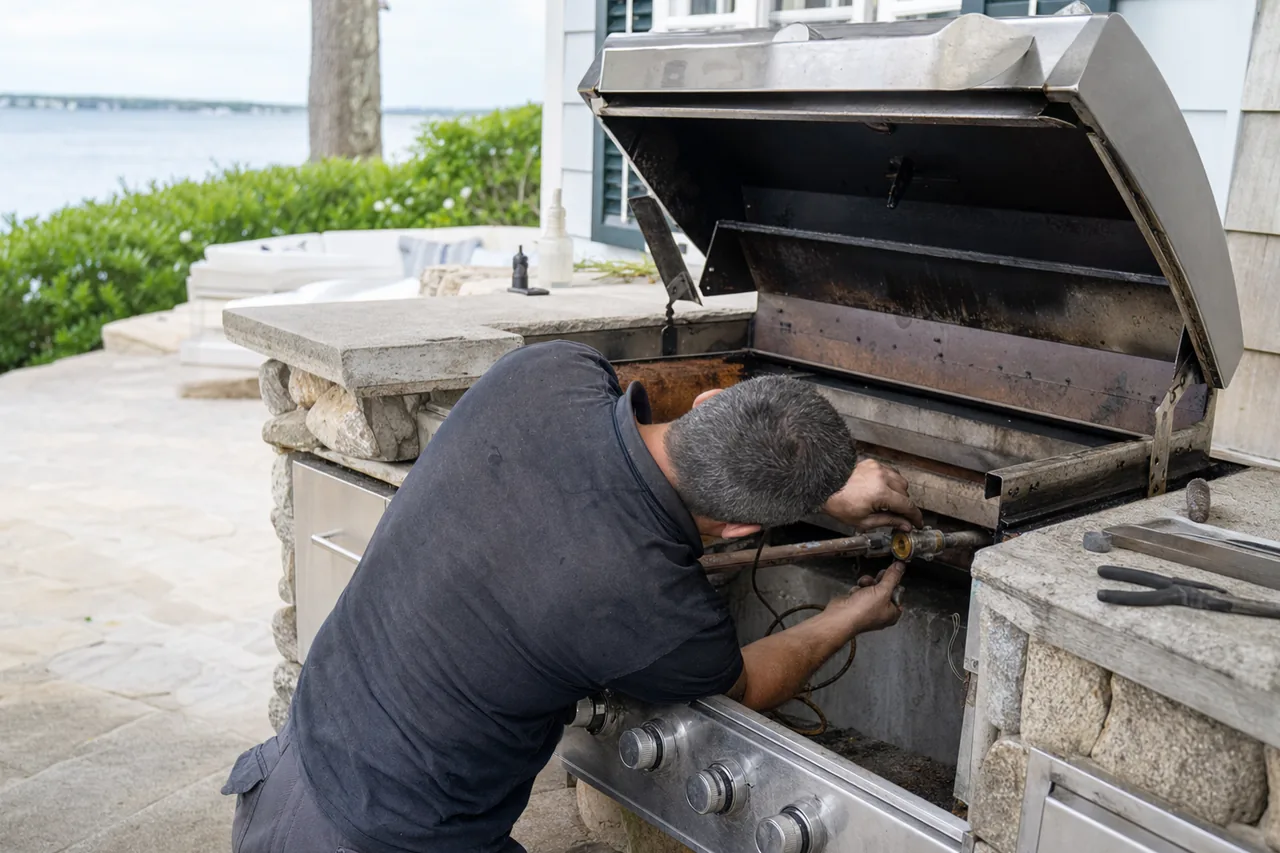
A professional rangetop is a simpler machine than the range it resembles: no oven cavity, no convection fan, no self-clean cycle. That means nearly every complaint traces to one of four things — the gas path, the spark path, the flame-sense path, or the way the caps sit on the ports. Sorting which one you have is a fifteen-minute job with the right meter and a straight edge.
Clicking that never stops
A spark module fires a set of electrodes until it sees flame. If one electrode is wet, cracked, carboned or sitting at the wrong gap, the module never sees the flame and keeps firing — often on every burner at once, because most modules spark the whole array together. Owners usually describe this as “all the burners click when I only turn on one,” which is normal behaviour on a module that cannot confirm ignition.
The first check is physical: electrode ceramic intact, tip clean, gap correct, and no spillage bridging the electrode to the burner body. Wiping a boiled-over sauce off an electrode has ended more service calls in this village than any part we stock.
Lights on high, dies on simmer
This is flame supervision doing exactly what it was designed to do. The safety device has to stay hot enough to hold the gas valve open. On high, the flame washes it constantly and nothing goes wrong. On simmer the flame retreats, the sensor cools, and the valve closes — which is safe, and also unusable.
Three causes, in the order we rule them out: a burner cap seated a millimetre proud, which pushes the flame away from the sensor; a sensor whose tip has oxidised and no longer reaches temperature; and a gas pressure or orifice mismatch, which is what you get when a unit built for natural gas was moved to propane or the reverse without a full conversion. That last one is worth naming early, because it is a setup fault, not a wear fault, and it will not improve with time.
Yellow, lifting or leaning flame
A correct flame on a sealed burner is stable, mostly blue, and anchored to the port ring the whole way round. Yellow tips mean the air/gas ratio is wrong or a port is partly blocked. A flame that lifts off the ring means too much pressure or too little port area. A flame leaning consistently to one side almost always means the cap is off its locating features — and caps get knocked out of position every time the grates come off for cleaning.
We seat every cap, clear every port with a proper tool rather than a paper clip, and only then take a pressure reading. Reversing that order wastes your money.
The simmer test we actually run
Anyone can turn a burner to low and say it works. We set the lowest stable setting, put a pan of water on it, and leave it for twenty minutes without touching the knob. A simmer that survives that is a simmer. A simmer that drops out at minute eleven was never fixed, it was warmed up — and that distinction is the difference between a repair and a second visit.
Grates, burner caps and the parts that get cleaned wrong
More rangetop faults come from cleaning than from wear. Burner caps and heads seat in one orientation and one position; a cap replaced slightly out of seat after a clean produces a lifting, uneven or noisy flame that looks like a gas problem and is not. Ports blocked by boil-over are cleared with a soft brush and a fine wire, never by drilling, which changes the port size permanently and the flame with it.
The igniter electrode has to stay dry and its ceramic has to stay unbroken. A cracked electrode arcs to the nearest metal instead of across the gap, which presents as continuous clicking with no light. Water sitting in a well after a clean produces exactly the same complaint until it dries, so a rangetop that clicks and will not light immediately after cleaning is worth leaving alone for an hour before anyone is called.
Grates are heavy, and a grate dropped onto a burner assembly can shift a head enough to break the flame path to its neighbour. If one burner started misbehaving on the day the top was cleaned, that is where we look first.
What the visit includes
A flat diagnostic, credited toward the repair when you approve it, and a written estimate before any part is ordered or any labor is billed. Everything we replace is a genuine OEM part.
What does a rangetop repair — clicks, no light cost before anyone has seen it?
Two figures decide this, and the schedule below carries both. The first is $80: a technician and a meter in front of the appliance, taken off the bill the moment you approve the repair. The second depends on which band the fault turns out to sit in — parts and labour counted together, this shop's book for St. Johns County, read off jobs of that class rather than off a manufacturer list.
| Band | Parts + labour | What lands in it |
|---|---|---|
| Diagnostic visit | $80 | Flat, credited to the repair when you approve it |
| Control board or touch panel | $410–$1,030 | board · control · panel · touch |
| Igniter or burner assembly | $190–$560 | igniter · ignitor · burner · flame |
A written estimate comes before any part is ordered or any labor is billed. A band says where this class of work usually lands. It is not a quote, and three things move a job inside it: how the appliance has to be reached, whether the part is stocked or ordered, and whether the number on the plate has been superseded since. The full schedule and the terms sit on the pricing sheet.
Rangetop repair — clicks, no light — the questions that come up on the phone
- Why do all the burners click when I only turned one on?
- Most spark modules fire the whole electrode array together and keep firing until they see flame. One wet, cracked or carboned electrode stops the module confirming ignition, so it sparks everything. Straight after a clean, water sitting in a well produces the same complaint until it dries.
- The burner is fine on high but dies on simmer. Is that a gas fault?
- It is flame supervision doing its job. On simmer the flame retreats from the safety device, the sensor cools and the valve shuts. We rule out a proud burner cap, then an oxidised sensor tip, then a pressure or orifice mismatch left behind by an incomplete fuel conversion.
- What counts as a repaired simmer?
- The lowest stable setting holding a pan of water for twenty minutes with nobody touching the knob. A simmer that drops out at minute eleven was warmed up, not repaired, and that distinction is the whole difference between one visit and two.
- What does a Viking rangetop repair cost in Nocatee?
- A rangetop that sparks without lighting, or dies at simmer, is a burner-and-ignition fault or the module driving it. On this book that is control board or touch panel $410–$1,030, igniter or burner assembly $190–$560, on top of the $80 diagnostic, credited back when you approve the work.
What owners said after rangetop repair — clicks, no light
Each slip below is one visit, in the words of the person who paid for it. The awkward ones are printed with the rest. More from the 78 we publish.
The simmer would not hold on the front burner and always dropped out after ten minutes. He set it low, put a pan of water on it and left it a full twenty minutes before calling it fixed.
Solomon E.2026-03-14
Every burner clicked whenever I turned on just one of them. It was a cracked electrode on the back left. He explained why the module sparks the whole array, changed it, and the clicking stopped for good.
Antonia G.2026-07-02
Constant clicking with no light, and it had started the day I cleaned the top. He told me on the phone to leave it an hour to dry, it still clicked, and the electrode ceramic turned out to be cracked.
Rufus W.2026-02-18
Reference sheets
Tolerances and intervals this page measures against, rangetop first.
Other equipment we service
Viking only, across the whole suite.
Viking kitchen appliances — and nothing mechanical in the house
Greenleaf Appliance Service repairs built-in kitchen appliances — the Viking equipment specified into a kitchen and installed in it, plus the outdoor cooking equipment that was specified with it. Home heating, air conditioning, heat pumps, air handlers and the ductwork that serves them are not work this shop takes, in Nocatee or anywhere else inside the radius. A hood duct, a condenser air path and the cooling load on a built-in are appliance work and we measure all three; the house's own mechanical systems belong to a mechanical contractor.
Viking on this site is the kitchen-appliance manufacturer. There is also a place called Viking in Indian River County, well south of St. Johns County; this shop does not work there, and it does not service heating or cooling equipment anywhere.
On the sheet
- Ranges, rangetops and cooktops
- Wall ovens, single and double
- Built-in and freestanding refrigeration
- Undercounter ice machines
- Dishwashers
- Range hoods and their blowers
- Outdoor cooking equipment specified with the kitchen
Off the sheet
- Home heating and furnaces
- Central air conditioning and heat pumps
- Air handlers and house ductwork
- Water heaters and pool equipment
- Laundry equipment