Reference · checklist
Parts and data plates
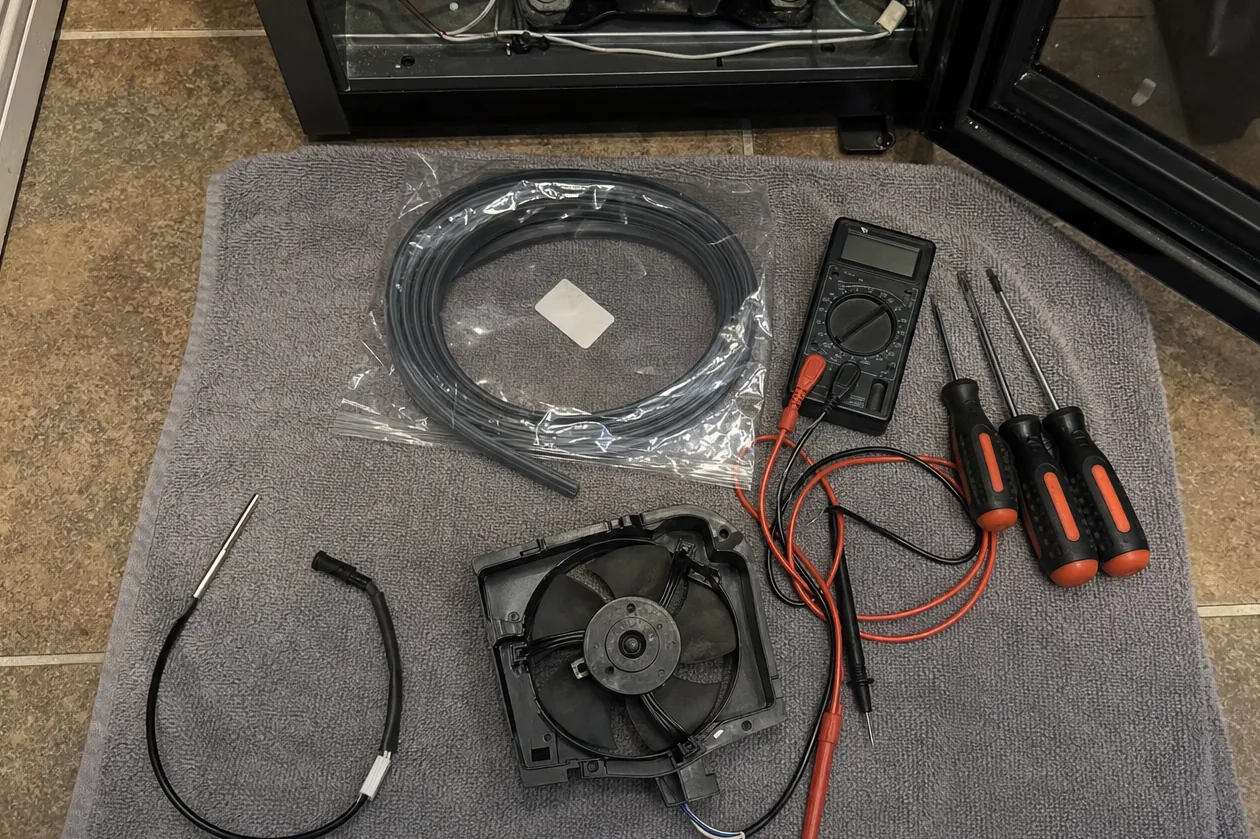
The single most useful thing a customer can do before a technician arrives is photograph the data plate. It costs two minutes, and it turns a two-visit repair into a one-visit repair more often than any diagnostic skill we have.
Why the plate decides everything
Professional appliances stay in production for years, and they change during that time. A sensor gets a different connector. An igniter gets a revised mount. A hinge kit is redesigned because the original fatigued. Two units that are indistinguishable from the front of the kitchen can take entirely different parts, and the only thing that separates them is the model and serial number on the plate.
Ordering against a description — “the tall one with the two ovens” — produces the wrong part often enough that we do not do it. Ordering against the plate produces the right part the first time.
Where the plate is
It is never on the front, because nobody wants to look at it. Common locations by class:
- Range. Behind the kick panel at the bottom, or on the frame behind the door when the door is opened fully.
- Rangetop or cooktop. Underneath the unit, which usually means it was recorded at installation or is reachable from the cabinet below.
- Wall oven. On the frame at the edge of the opening, visible with the door open, sometimes behind the door trim.
- Refrigeration. On the interior side wall of the fresh food compartment, or on the ceiling of it near the front, sometimes behind a crisper.
- Dishwasher. On the edge of the door or on the tub frame it closes against.
- Ice machine. Behind the front grille, or on the rear panel.
- Ventilation. Inside the canopy with the baffle filters removed.
Photograph it, do not transcribe it. Serial numbers contain characters that are easy to mistake by eye, and a single wrong character orders a part for a different unit.
What we do with it
We look up the parts list for that model and serial, which resolves any running change that applies to your unit. Where a part has been superseded we say what it superseded to and why, rather than presenting a replacement as the original. Where a part is discontinued with no equivalent, we say that too — a substitute that does not belong in the machine is worse than an honest dead end, and it is the point at which repair-versus-replace becomes the real conversation.
Stock, lead time and second visits
Wear items are the parts that fail most and the parts most likely to be on the truck or at a local supplier: gaskets, igniters, sensors, thermostats, fan motors, filters, common valves. Structural and electronic parts — control boards, hinge kits, glass, panels, compressors — are generally ordered.
That is why the diagnostic visit and the repair visit are sometimes two appointments. We would rather tell you that on the phone than arrive with an optimistic guess about what your appliance needs. Lead time depends on the supplier on the day, so we quote it when we order rather than printing a figure here that would be wrong half the time.
Two practical consequences. First, if a part has a long lead time and the appliance is a refrigerator, we will talk about how to live without it or whether to keep it running in a limited way in the meantime. Second, if the part is a board on a unit that has already had two other failures, the arithmetic deserves a frank conversation before it is ordered rather than after it arrives.
Repair or replace, with the numbers on the table
Built-in equipment is not a disposable class of appliance. The structure — the cabinet, the doors, the burners, the compressor, the cavity — routinely outlives its consumables by a wide margin, which is why replacing a sensor, an igniter, a gasket or a fan motor on an older unit is usually sound value. Replacement is also expensive in a way that has nothing to do with the appliance: an opening built for one unit rarely takes the next one without cabinet work.
What changes the arithmetic is a high-value part on a machine that has already shown other failures, or a sealed-system repair on refrigeration late in its life. In those cases you get the part cost, the labor, the condition of everything around it, and our opinion. The decision stays yours, and we have nothing to sell you if you decide to replace.
What does the work on this sheet cost before anyone has seen it?
Two figures decide this, and the schedule below carries both. The first is $80: a technician and a meter in front of the appliance, taken off the bill the moment you approve the repair. The second depends on which band the fault turns out to sit in — parts and labour counted together, this shop's book for St. Johns County, read off jobs of that class rather than off a manufacturer list.
| Band | Parts + labour | What lands in it |
|---|---|---|
| Diagnostic visit | $80 | Flat, credited to the repair when you approve it |
| Igniter or burner assembly | $190–$560 | igniter · ignitor · burner · flame |
| Oven thermostat or heating element | $190–$590 | oven · bake · broil · temperature |
| Control board or touch panel | $410–$1,030 | board · control · panel · touch |
| Refrigeration fan or defrost system | $240–$610 | refrigeration · fan · defrost · cooling |
| Dishwasher pump or control | $240–$690 | dishwash · pump · drain |
| Compressor or sealed-system repair | $940–$2,440 | compressor · sealed · refrigerant · freezer |
A written estimate comes before any part is ordered or any labor is billed. A band says where this class of work usually lands. It is not a quote, and three things move a job inside it: how the appliance has to be reached, whether the part is stocked or ordered, and whether the number on the plate has been superseded since. The full schedule and the terms sit on the pricing sheet.
Parts and data plates — questions from the kitchen side
- Why does the data plate decide everything?
- Because the model and serial say which running change your unit takes, and a part that fits the family may not fit the revision. Photograph the plate before you call and the right part gets ordered once instead of twice.
- Where is the plate likely to be?
- Inside the door, along the frame, behind the kick panel, or on the back of a drawer, depending on the class of appliance. If you cannot find it, say so when you book: it takes a technician a minute and it beats guessing at a number.
- Why does a part sometimes mean a second visit?
- Because wear items are stocked and platform-specific parts are not. A common valve or element ships in days; a board, a hinge kit or a panel is ordered against your plate, and where a number has been superseded we say what it superseded to before it goes on the estimate.
Visits where this sheet decided the answer
Each slip below is one visit, in the words of the person who paid for it. The awkward ones are printed with the rest. More from the 78 we publish.
The hood light worked but the fan did nothing at any speed. He found the speed control burnt at one terminal and replaced it, then checked the duct run length against what the blower is actually rated to move.
Willa O.2026-02-19
Salt air had pitted the burner caps until two of them would not seat properly. He cleaned the burner bases, fitted new caps and showed me how to dry them off after a week of onshore wind.
Marlene K.2026-05-14
The dishwasher started tripping the breaker. He isolated a harness that had rubbed through against the frame and repaired it properly instead of taping over it. Nothing has tripped in the months since.
Rosalie K.2026-03-16
Where this sheet is used
A site-wide reference: every service page on the site works against it.
Viking kitchen appliances — and nothing mechanical in the house
Greenleaf Appliance Service repairs built-in kitchen appliances — the Viking equipment specified into a kitchen and installed in it, plus the outdoor cooking equipment that was specified with it. Home heating, air conditioning, heat pumps, air handlers and the ductwork that serves them are not work this shop takes, in Nocatee or anywhere else inside the radius. A hood duct, a condenser air path and the cooling load on a built-in are appliance work and we measure all three; the house's own mechanical systems belong to a mechanical contractor.
Viking on this site is the kitchen-appliance manufacturer. There is also a place called Viking in Indian River County, well south of St. Johns County; this shop does not work there, and it does not service heating or cooling equipment anywhere.
On the sheet
- Ranges, rangetops and cooktops
- Wall ovens, single and double
- Built-in and freestanding refrigeration
- Undercounter ice machines
- Dishwashers
- Range hoods and their blowers
- Outdoor cooking equipment specified with the kitchen
Off the sheet
- Home heating and furnaces
- Central air conditioning and heat pumps
- Air handlers and house ductwork
- Water heaters and pool equipment
- Laundry equipment