Reference · reference
Oven calibration tolerance
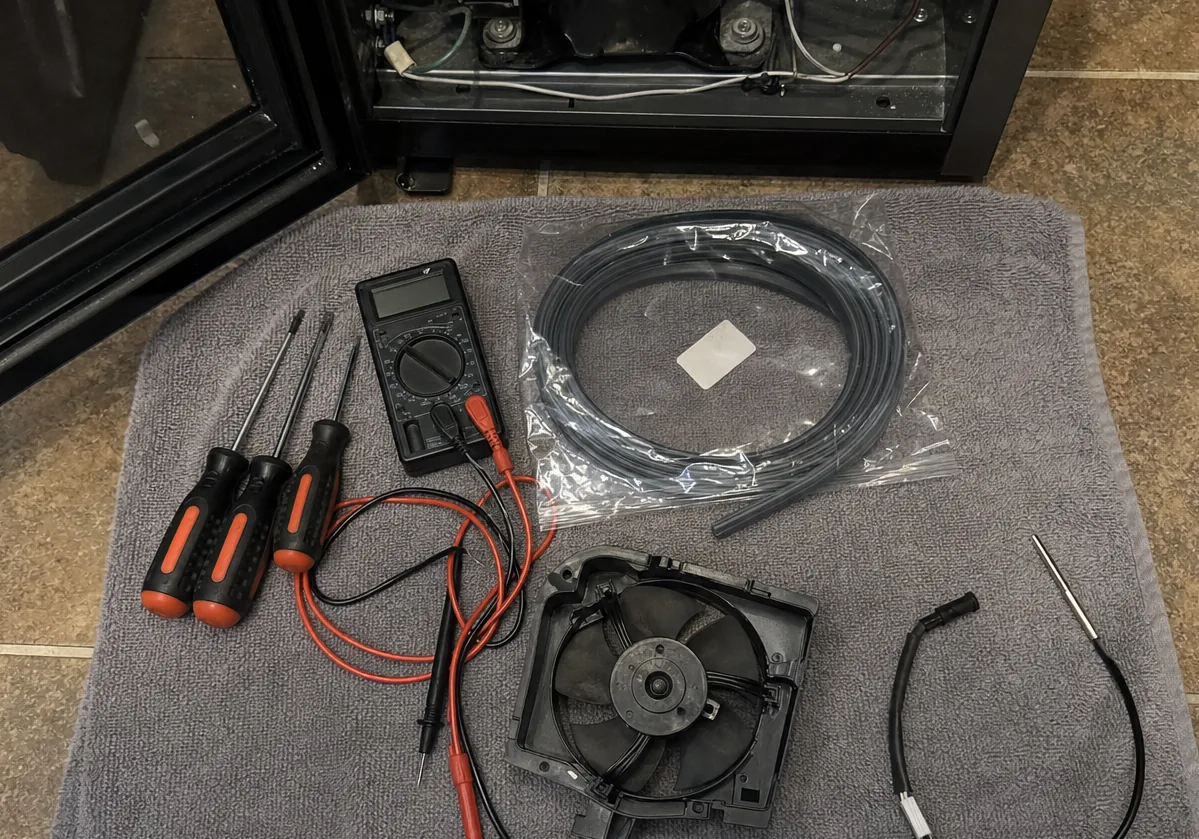
Almost every “my oven is off” call resolves into one of four measurable behaviours, and the measurement takes half an hour with a thermometer. This page is the procedure we use, written out so you can run it yourself before deciding whether to call anyone.
Why the display is not evidence
The number on the control panel is the control’s belief about the cavity, derived from the resistance of a single temperature sensor. If that sensor has drifted, the control will hold the wrong temperature with complete accuracy and report success. Nothing on the panel can tell you it is wrong. Only an independent thermometer can.
Use an oven thermometer or a probe you trust. Put it at the centre of the middle rack, not touching metal, not against the wall, and not on the floor of the cavity where radiant heat from the element will read high.
The procedure
- Remove everything except the middle rack. Stone, steel and heavy pans store heat and will flatten the swing you are trying to observe.
- Set 350°F. It is high enough to be representative and low enough that a miscalibrated cavity does not damage anything during the test.
- Wait for the preheat signal, then wait a further twenty minutes. A cavity announces preheat long before its walls and racks are in equilibrium, and a reading taken at the tone is not a reading.
- Note the temperature every two minutes for three full cycles — that is, three times the element or burner comes on and goes off again.
- Write down the highest, the lowest, and the average.
Reading the result
| What you measured | What it points at |
|---|---|
| Average within 10°F, swing within 25°F | Cavity is healthy; the problem is technique or a recipe |
| Average consistently 20–50°F low or high, tight swing | Sensor drift or calibration offset |
| Average correct, swing 40°F or more | Control relay or element behaviour |
| Climbs, stalls below setpoint, never arrives | Heat loss — door seal, hinge sag, or a failed element |
| Wildly different readings run to run | Intermittent connection at the sensor or the element |
The distinction between average and swing is the whole point of measuring three cycles. A single reading cannot separate them, which is why one-reading diagnoses are so often wrong.
Calibration offset is not a repair
Most professional ovens allow an offset to be entered so the control shifts its target. That is the right fix when a cavity is uniformly low or high by a modest amount and the swing is tight — the sensor is honest and slightly out, and the offset corrects it.
It is the wrong fix for everything else. Dialling in a 40°F offset to compensate for a door that no longer seals hides the fault and makes the oven worse at every setpoint except the one you tested. If the cavity cannot hold a swing, an offset will not give it one.
The door is the most underestimated component
A gasket that has taken a set, or a hinge spring that has fatigued enough to let the door drop a few millimetres at the top, produces a continuous heat loss at the top corner. The cavity chases it forever. This presents as slow preheat, long recovery after the door is opened, and a cavity that reads low at high setpoints while behaving acceptably at low ones — because the loss is proportional to the temperature difference.
Check it with the door closed and a straight edge across the frame, and check the gasket by hand around its whole perimeter for flat spots and hardening. Both parts are inexpensive. Between them they explain a large share of the calibration complaints we are called out for.
Faults that are not the oven
Three complaints arrive regularly as calibration problems and are not.
Rack position and cookware. A dark, heavy pan on the lowest rack sits in the radiant path of the bottom element and browns far faster than the same batch on the centre rack. Nothing about the cavity is wrong. Glass and stoneware hold heat and keep cooking after the door opens; thin sheet pans do not.
Convection expectations. A convection setting moves air, which transfers heat faster at the same measured cavity temperature. A recipe written for a conventional oven will run ahead of schedule in a convection one, and the cavity is behaving exactly as designed.
Preheat believed too early. Most cavities signal preheat before their walls, racks and any stone inside them have reached temperature. Food entering at the tone meets a cavity that is up to temperature in the air and cold in the mass around it, which is a genuinely different cooking environment and reads as an oven running low.
Measure first, using the procedure above. If the average and the swing are both inside tolerance, the oven is not the variable, and no adjustment to it will fix the result on the shelf.
What does the work on this sheet cost before anyone has seen it?
Two figures decide this, and the schedule below carries both. The first is $80: a technician and a meter in front of the appliance, taken off the bill the moment you approve the repair. The second depends on which band the fault turns out to sit in — parts and labour counted together, this shop's book for St. Johns County, read off jobs of that class rather than off a manufacturer list.
| Band | Parts + labour | What lands in it |
|---|---|---|
| Diagnostic visit | $80 | Flat, credited to the repair when you approve it |
| Oven thermostat or heating element | $190–$590 | oven · bake · broil · temperature |
| Control board or touch panel | $410–$1,030 | board · control · panel · touch |
A written estimate comes before any part is ordered or any labor is billed. A band says where this class of work usually lands. It is not a quote, and three things move a job inside it: how the appliance has to be reached, whether the part is stocked or ordered, and whether the number on the plate has been superseded since. The full schedule and the terms sit on the pricing sheet.
Oven calibration tolerance — questions from the kitchen side
- How far off is too far off?
- More than about ten degrees from the setpoint once the cavity has stabilised, or a swing that stays wide across three cycles. One reading is a snapshot. Three cycles show whether the cavity drifts, swings or never arrives, and those three behaviours point at three different components.
- Is a calibration offset a repair?
- No. An offset shifts what the control is aiming at; it does not fix a sensor that has drifted, an element that cycles badly, or a door venting heat past a compressed gasket. Dialling in an offset over a real fault hides it for a few weeks and leaves the cause exactly where it was.
- Why does the door deserve to be suspected earlier than it is?
- Because a cavity that climbs, stalls and never arrives is losing heat faster than it can make it, and the cheapest part of the oven is usually where it goes. A hinge that has sagged or a gasket with flat spots costs very little and is frequently the whole answer.
Visits where this sheet decided the answer
Each slip below is one visit, in the words of the person who paid for it. The awkward ones are printed with the rest. More from the 78 we publish.
Grease had started dripping back down onto the cooktop. He found the filters refitted the wrong way round by whoever cleaned them last and the collection tray brimming. Cleaned, refitted, and it has stayed dry.
Yolanda M.2026-04-10
A smell from the dishwasher would not shift no matter what we ran through it. He cleared the drain, replaced a check valve letting waste water back in and cleaned under the filter plate. It needed a second visit.
Tamara J.2025-10-08
Our ice machine had slowed to a trickle by August, which is exactly when we need it. He descaled the evaporator plate, fitted a water inlet valve that had barely been opening, and production came straight back.
Corinne F.2026-08-09
Where this sheet is used
Service pages that measure against these figures.
Viking kitchen appliances — and nothing mechanical in the house
Greenleaf Appliance Service repairs built-in kitchen appliances — the Viking equipment specified into a kitchen and installed in it, plus the outdoor cooking equipment that was specified with it. Home heating, air conditioning, heat pumps, air handlers and the ductwork that serves them are not work this shop takes, in Nocatee or anywhere else inside the radius. A hood duct, a condenser air path and the cooling load on a built-in are appliance work and we measure all three; the house's own mechanical systems belong to a mechanical contractor.
Viking on this site is the kitchen-appliance manufacturer. There is also a place called Viking in Indian River County, well south of St. Johns County; this shop does not work there, and it does not service heating or cooling equipment anywhere.
On the sheet
- Ranges, rangetops and cooktops
- Wall ovens, single and double
- Built-in and freestanding refrigeration
- Undercounter ice machines
- Dishwashers
- Range hoods and their blowers
- Outdoor cooking equipment specified with the kitchen
Off the sheet
- Home heating and furnaces
- Central air conditioning and heat pumps
- Air handlers and house ductwork
- Water heaters and pool equipment
- Laundry equipment