Service · range
Range repair — burner and setpoint
Sealed burners that will not stay lit, ovens that miss the setpoint, and doors that no longer hold a seal — on Viking ranges in Nocatee and St. Johns County.
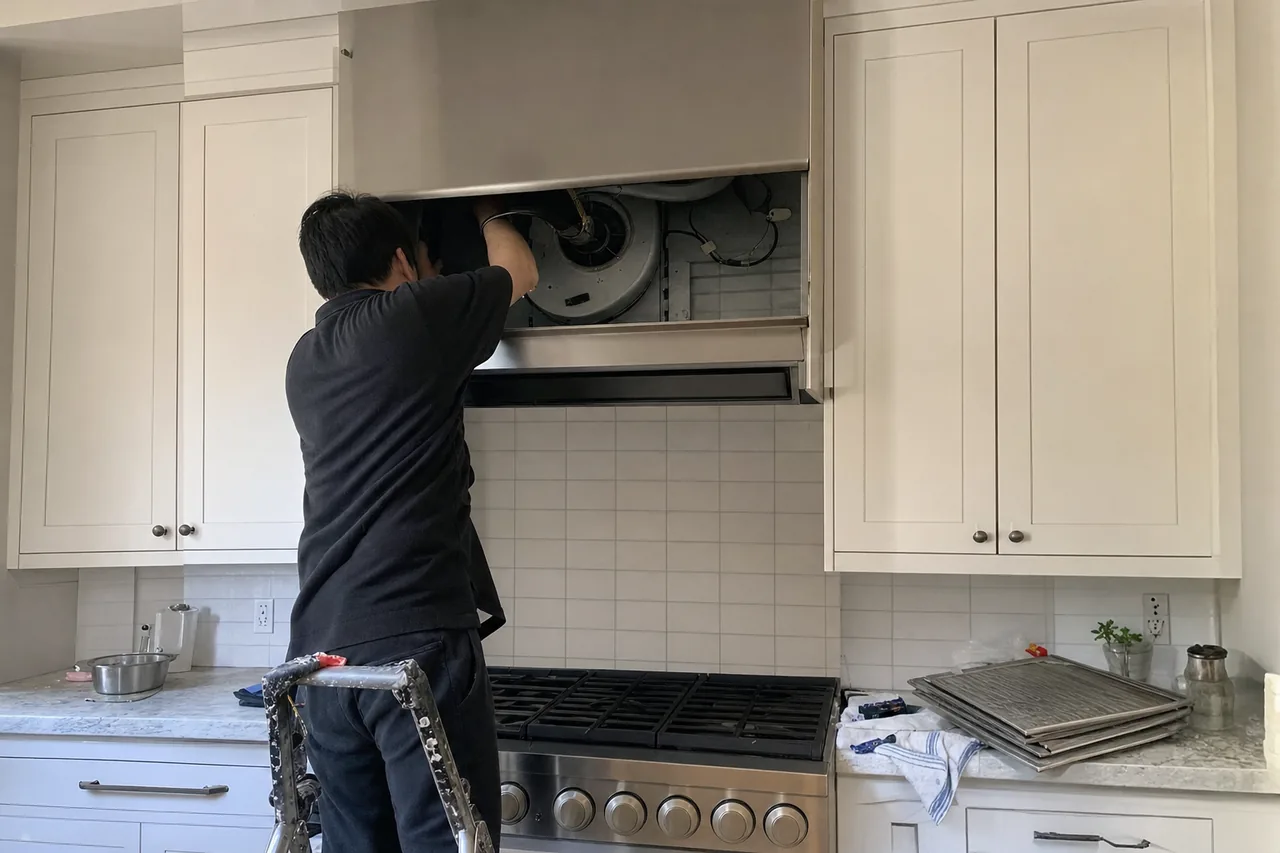
A professional range fails in a small number of ways, and most of them announce themselves before the appliance stops working. The job on the first visit is to measure which one you have, not to guess at it and then order a part on your money.
Burner drops out after release
On a sealed burner with flame supervision, the safety device has to be hot enough to hold the gas valve open by the time you let go of the knob. When the burner lights and then dies a few seconds later, the fault is almost always in that heat-sensing path — the sensor, its connection, or the valve it holds open. It is not a sign that the range is worn out.
Before that gets diagnosed, the burner cap and the port ring get cleaned and seated. A cap sitting a millimetre proud changes the flame pattern enough to starve the sensor, and that costs nothing to correct. Caps get knocked out of position every time the grates come off for cleaning, so this is a recurring cause rather than a one-off.
Igniter glows but nothing lights
On an oven burner with a glow-bar igniter, the igniter is also the current sensor: the gas valve opens only once enough current is flowing through the hot igniter to prove it is at ignition temperature. An igniter that has aged draws less current as it goes, so the first symptom is not a failure to glow but a long delay before lighting, then a very long delay, then nothing. Owners often report that the oven “takes forever to preheat” for months before it quits. A glowing igniter is therefore not proof of a good igniter, and anyone who tells you otherwise is reading the wrong evidence.
Oven misses the setpoint
We check calibration against a thermometer on the centre rack with the cavity stabilised, not against the display. The display shows what the control believes from one sensor reading; if the sensor has drifted, the control will defend the wrong temperature very accurately.
A cavity that settles more than about 10°F from the setpoint, or that swings wide across three cycles, is telling you something about the sensor, the element or the door seal — in that order of likelihood. A cavity that is consistently low points at calibration or the sensor. A cavity that averages right but swings 40°F either way points at the control or the element. A cavity that climbs, stalls and never arrives is losing heat faster than it can make it, which points at the door.
Door and seal
The seal is the cheapest part of an oven and the one that ruins the most cooking. A door that has dropped at the hinge lets heat out of the top corner, and the cavity chases the loss forever. Hinges are checked for sag with a straight edge across the frame before anything electrical is condemned, and the gasket is checked by hand around its whole perimeter for flat spots and hardening.
Uneven browning with the convection fan running
A running fan is not the same as a working convection system. If the fan turns but food still browns unevenly, look at the rear baffle — if it is missing, loose or fitted with the wrong clearance after a cleaning, the fan recirculates air in a pocket instead of drawing it through the cavity. The other candidate is the convection element itself, which can fail while the fan continues to run, leaving you with a very effective air mover and no additional heat.
A note on the local cohort
Nocatee homes date from 2007 onward, and a large share of the professional ranges here were installed by the builder within a few years of one another. They are now aging as a group, which is why one street produces several calls in a season and why the same three parts come up repeatedly. It also means most of these appliances are well past any manufacturer coverage, so the economics of repair versus replacement are worth an honest conversation rather than an assumption.
What the visit includes
A flat diagnostic, credited toward the repair when you approve it, and a written estimate before any part is ordered. Everything we replace is a genuine OEM part.
What does a range repair — burner and setpoint cost before anyone has seen it?
Two figures decide this, and the schedule below carries both. The first is $80: a technician and a meter in front of the appliance, taken off the bill the moment you approve the repair. The second depends on which band the fault turns out to sit in — parts and labour counted together, this shop's book for St. Johns County, read off jobs of that class rather than off a manufacturer list.
| Band | Parts + labour | What lands in it |
|---|---|---|
| Diagnostic visit | $80 | Flat, credited to the repair when you approve it |
| Control board or touch panel | $410–$1,030 | board · control · panel · touch |
| Oven thermostat or heating element | $190–$590 | oven · bake · broil · temperature |
| Igniter or burner assembly | $190–$560 | igniter · ignitor · burner · flame |
A written estimate comes before any part is ordered or any labor is billed. A band says where this class of work usually lands. It is not a quote, and three things move a job inside it: how the appliance has to be reached, whether the part is stocked or ordered, and whether the number on the plate has been superseded since. The full schedule and the terms sit on the pricing sheet.
Range repair — burner and setpoint — the questions that come up on the phone
- Why does a sealed burner light and then drop out when I let go of the knob?
- The flame safety device has to be hot enough to hold the gas valve open by the time the knob is released. Nine calls out of ten the fault sits in that heat-sensing path, or in a burner cap seated a millimetre proud after a clean. It is not a sign the range is finished.
- My igniter glows, so surely the igniter is fine?
- Not necessarily. On a glow-bar oven burner the igniter is also the current sensor, and the gas valve opens only once enough current is flowing through it. An aged igniter still glows while drawing too little, so the first symptom is a long delay before lighting, then no light at all.
- How do you decide an oven is out of calibration?
- With a thermometer on the centre rack, the cavity stabilised for twenty minutes, and at least three full cycles watched. The display only reports what the control believes from one sensor. A consistent offset points at the sensor, a wide swing at the control or element, a stall at the door.
- What does a Viking range repair cost in Nocatee?
- Most range calls end in the flame-sensing path, the oven heat source or the control. On this book that is control board or touch panel $410–$1,030, oven thermostat or heating element $190–$590, igniter or burner assembly $190–$560, on top of the $80 diagnostic, credited back when you approve the work.
What owners said after range repair — burner and setpoint
Each slip below is one visit, in the words of the person who paid for it. The awkward ones are printed with the rest. More from the 78 we publish.
Bake element heated but the cavity never got where it had been set. He found a torn door seal letting heat out along the top and changed that before condemning anything electrical. The setpoint holds now.
Ignacio M.2026-01-09
One burner dropped out every single time the knob was released. He replaced the flame sensing thermocouple and checked the rest of the set while he was down at that level. It has stayed lit for a month.
Terrence O.2025-11-19
The oven had been running cold since the day it went in and nobody had ever measured it. He stabilised the cavity, read three cycles and traced it to the door seal rather than the element everyone blamed.
Marguerite C.2026-04-03
Reference sheets
Tolerances and intervals this page measures against, range first.
Other equipment we service
Viking only, across the whole suite.
Viking kitchen appliances — and nothing mechanical in the house
Greenleaf Appliance Service repairs built-in kitchen appliances — the Viking equipment specified into a kitchen and installed in it, plus the outdoor cooking equipment that was specified with it. Home heating, air conditioning, heat pumps, air handlers and the ductwork that serves them are not work this shop takes, in Nocatee or anywhere else inside the radius. A hood duct, a condenser air path and the cooling load on a built-in are appliance work and we measure all three; the house's own mechanical systems belong to a mechanical contractor.
Viking on this site is the kitchen-appliance manufacturer. There is also a place called Viking in Indian River County, well south of St. Johns County; this shop does not work there, and it does not service heating or cooling equipment anywhere.
On the sheet
- Ranges, rangetops and cooktops
- Wall ovens, single and double
- Built-in and freestanding refrigeration
- Undercounter ice machines
- Dishwashers
- Range hoods and their blowers
- Outdoor cooking equipment specified with the kitchen
Off the sheet
- Home heating and furnaces
- Central air conditioning and heat pumps
- Air handlers and house ductwork
- Water heaters and pool equipment
- Laundry equipment