Guide
How to Change the Water Filter in a Viking Refrigerator, Model by Model
Where the cartridge sits on each Viking refrigerator family, which part it takes, how often to swap it, and what a clogged or wrong filter does to ice and water.
Changing the water filter in a Viking refrigerator comes down to five moves: locate the cartridge, turn the spent one out, lock the replacement in, run water through the dispenser, and clear the filter reminder. Which cartridge you need, and where it hides, depends on the model. On the integrated columns, part RWFDISP lives in the bottom right corner behind the door and unlocks with a counterclockwise quarter turn; a tap on the illuminated FILTER key afterward restarts the count.
Read the model plate before you buy a cartridge
Viking has used several filter designs, and a cartridge from one family will not lock into another, so start with the model number. On a 5 Series built-in, the serial and model numbers are printed on the upper wall inside the cabinet, tucked behind the light. On the FDREIC all-refrigerator and its FDFZIC and FDBMIC7360 relatives, the product plate is inside the fresh-food section on the wall opposite the door opening.
Older built-in refrigerator/freezers covered by Viking manual F20413, including the VCSB423 and VCBB363, use their own cartridge, so confirm against that manual or the plate before ordering anything.
Which cartridge goes where, and how often
- RVFFR336 French-door: part RWFRVFFR, replaced every 6 months, reminder cleared by holding Alarm Off for 3 seconds.
- Integrated refrigerator and freezer columns with a door dispenser: part RWFDISP, a quarter-turn cartridge at the lower right behind the door, reset with the lit FILTER button.
- FDREIC integrated all-refrigerator: part RWFIC. The internal filter in FDREIC, FDFZIC and FDBMIC7360 units is rated for up to 3,000 litres (792.6 gal) and never more than 12 months.
- F20413 legacy built-ins: a fresh cartridge every nine months or after 750 gallons, whichever arrives sooner.
Treat those numbers as ceilings. A kitchen that fills pitchers and the coffee maker from the door can reach the gallon limit well before the calendar does.
Swapping the cartridge without a mess
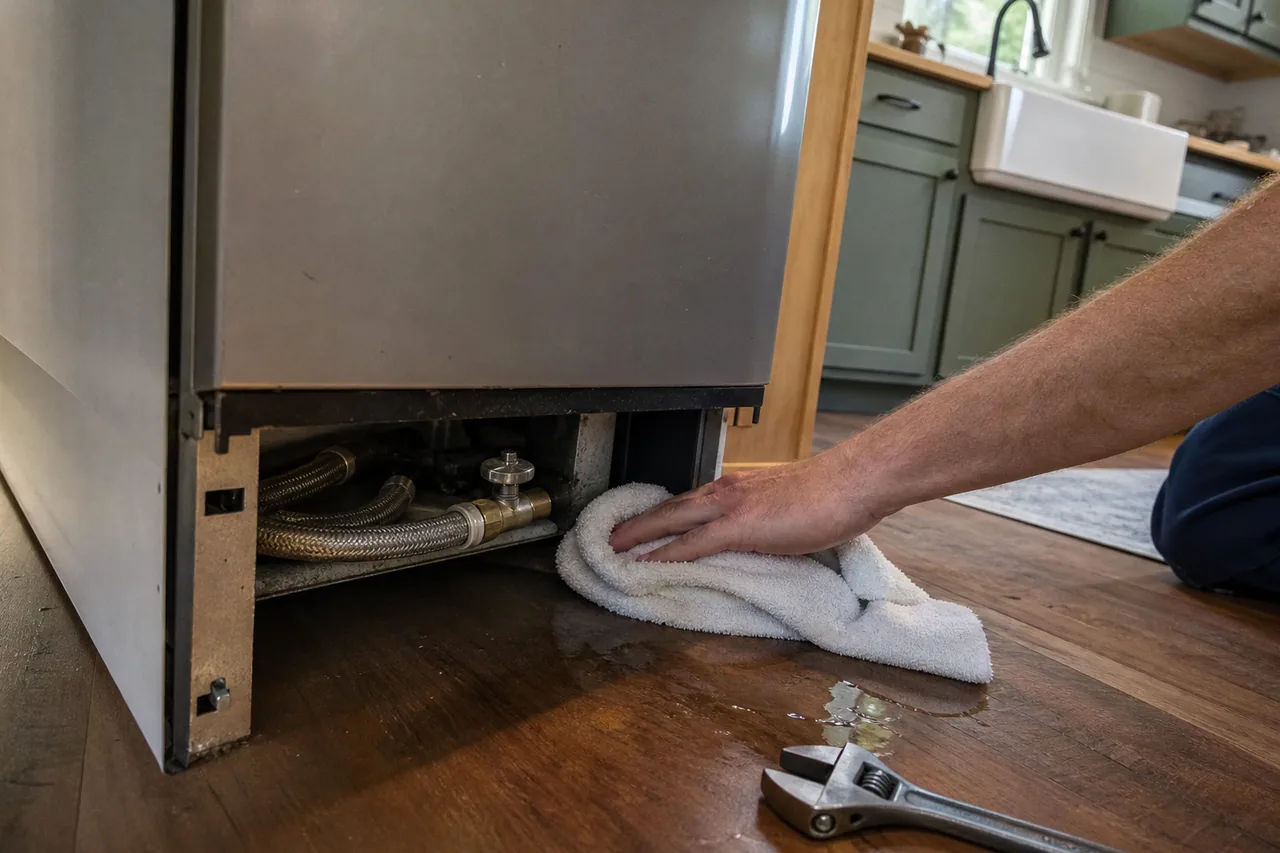
Fold a towel under the filter housing first, because a little water nearly always escapes when the old cartridge lets go. Turn the old one counterclockwise until it releases and draw it straight out, keeping it level; it is full of water and heavier than it looks.
Pull the protective cap off the new cartridge, line it up with the housing, press it home and turn it clockwise until it stops firmly. Do not force it past that stop. Wipe the housing dry and watch it for a minute or two. A joint that stays dry tells you the seals are seated. Write the date on a strip of tape inside the door for next time.
Flush the line, then clear the reminder
A new cartridge arrives full of air and fine carbon dust. Hold a large glass against the dispenser and let water run; the F20413 manual asks for three minutes of flow, which is a sensible routine on any Viking. Early sputtering and cloudy water are normal. Dump the first batch of ice as well, since it formed while the line was still purging. Viking applies the same thinking to a newly installed 5 Series built-in: allow 24 to 48 hours before ice appears, discard the first three full drawers, and throw out the first drawer made after the refrigerator has sat unused for a long stretch.
Then reset the reminder: Alarm Off for 3 seconds on the RVFFR336, the illuminated FILTER key on RWFDISP models. On the FDREIC family, a reset starts a new 12-month count, and the display shows Replace filter when that period runs out.
What water quality does to the filter, the ice and the refrigerator
The cartridge is the only barrier between the house supply and the parts that make ice. Sediment, scale and chlorine all shorten its life. Once the carbon block loads up, flow drops and the ice maker receives less water on each fill, so cubes come out small, hollow or crescent-thin and the bin never seems full. A clogged cartridge also makes the inlet valve fight extra restriction, and grit that slips past a poorly seated filter can lodge in that valve.
Taste gives early warning too. When water from the door starts to taste like the kitchen tap again, the carbon is spent, even if the reminder has not lit. A filter does not soften water, so chalky white scale on the drip tray or in the ice bin points to hard water rather than a bad cartridge.
Supply pressure matters as much as the filter does. For the FDREIC, Viking calls for a 1/4-inch copper water line delivering 20 to 120 psi. Below that range, even a brand-new cartridge will fill a glass slowly.
When a new filter does not fix the problem
First confirm the cartridge turned fully to its stop, open the supply valve all the way, and look behind or beneath the unit for a kinked or crushed line. A cartridge from another design, or a look-alike that does not seal well, can leak at the head or let water bypass the carbon, so stay with the part number listed for your model.
If dispensing stays weak, the ice maker sits idle, or the fill tube keeps freezing, the fault lies beyond the filter. A fill tube that freezes again and again can trace back to the freezer section or its defrost system, and fan or defrost repairs on Viking refrigeration typically fall in the $240–$610 range, with the firm price given after the $80 diagnostic. Greenleaf Appliance Service handles Viking refrigerator repair and ice machine repair around Nocatee, from Twenty Mile to Coastal Oaks.
Looking for an air filter? Start at the lower grille
Searching for an air filter? Check your use and care manual to see whether your model has one at all. On the models above, the airflow item that needs regular care is the condenser behind the lower grille. A 5 Series built-in uses a Super Clog-Resistant pin-and-tube condenser that is meant to run without routine cleaning; if dust does build up, a vacuum with a long, narrow nozzle clears it. The FDREIC, FDFZIC and FDBMIC7360 units post CHECK COND. every 6 months: switch the unit off at its power key, wait about 30 minutes, remove the grille below the door, brush and vacuum the coil, then restart and clear the message. A blinking CL on the temperature readout of the RWFDISP integrated columns is a request for that same coil cleaning; press the up and down arrow keys together for 3 seconds to dismiss it. Whatever the model, keep lint and pet hair off the front grille so air can reach the coil.
What does the work this guide describes cost before anyone has seen it?
Two figures decide this, and the schedule below carries both. The first is $80: a technician and a meter in front of the appliance, taken off the bill the moment you approve the repair. The second is the one band on this book that covers the work this guide describes: refrigeration fan or defrost system, parts and labour counted together, read off jobs of that class in St. Johns County rather than off a manufacturer list. The book carries no band of its own for the rest of it, so anything else the visit turns up is priced on the written estimate after the diagnostic instead of being guessed at in advance.
| Band | Parts + labour | What lands in it |
|---|---|---|
| Diagnostic visit | $80 | Flat, credited to the repair when you approve it |
| Refrigeration fan or defrost system | $240–$610 | refrigeration · fan · defrost · cooling |
A written estimate comes before any part is ordered or any labor is billed. A band says where this class of work usually lands. It is not a quote, and three things move a job inside it: how the appliance has to be reached, whether the part is stocked or ordered, and whether the number on the plate has been superseded since. The full schedule and the terms sit on the pricing sheet.
Refrigerator water filter — questions from the kitchen side
- How often should I change the water filter in my Viking refrigerator?
- It depends on the model. The RVFFR336 French-door wants a new RWFRVFFR every 6 months. Older built-ins under manual F20413 call for a change every nine months or 750 gallons, whichever is first. The FDREIC family allows up to 12 months or 3,000 litres. Heavy use or gritty water means sooner.
- Where is the water filter on a Viking integrated column refrigerator?
- On integrated columns that take RWFDISP, open the door and look low on the right side. The cartridge comes out with a quarter turn counterclockwise. On the FDREIC all-refrigerator the RWFIC filter is internal, inside the fresh-food compartment.
- Why is the water still slow after I put in a new filter?
- Usually air is still in the line or the cartridge did not turn all the way to its stop. Run the dispenser a few more minutes, reseat the cartridge, and confirm the supply valve is fully open and the line is not kinked. If flow stays weak, the inlet valve or supply pressure needs a closer look.
- Does a Viking refrigerator have an air filter?
- Check the use and care manual for your exact model before buying one. On the Viking built-ins and integrated units covered in this guide, the airflow item that needs routine attention is the condenser behind the lower grille, which you keep clear of dust and lint.
- Should I throw away the first ice after changing the filter?
- Yes, it is a good habit. The first batch forms while air and loose carbon are still purging from the new cartridge, so dump it and let the ice maker refill the bin with clean cubes. Viking gives a similar rule after installation and after long periods without use.
Where this guide applies
The service pages for this appliance.
Viking kitchen appliances — and nothing mechanical in the house
Greenleaf Appliance Service repairs built-in kitchen appliances — the Viking equipment specified into a kitchen and installed in it, plus the outdoor cooking equipment that was specified with it. Home heating, air conditioning, heat pumps, air handlers and the ductwork that serves them are not work this shop takes, in Nocatee or anywhere else inside the radius. A hood duct, a condenser air path and the cooling load on a built-in are appliance work and we measure all three; the house's own mechanical systems belong to a mechanical contractor.
Viking on this site is the kitchen-appliance manufacturer. There is also a place called Viking in Indian River County, well south of St. Johns County; this shop does not work there, and it does not service heating or cooling equipment anywhere.
On the sheet
- Ranges, rangetops and cooktops
- Wall ovens, single and double
- Built-in and freestanding refrigeration
- Undercounter ice machines
- Dishwashers
- Range hoods and their blowers
- Outdoor cooking equipment specified with the kitchen
Off the sheet
- Home heating and furnaces
- Central air conditioning and heat pumps
- Air handlers and house ductwork
- Water heaters and pool equipment
- Laundry equipment